
Compare horse racing betting sites by checking the price for the same horse, the each-way places and the rules attached to your bet. Start with a licence check, then look at race coverage, streaming requirements and withdrawals. A welcome offer alone tells you little about how a bookmaker will suit the way you follow racing.
Use the comparison below to explore the available bookmakers, then read our guide to the features and conditions worth checking. We cover UK and Irish horse racing, common bet types, mobile betting and the rules that can change a payout. For a broader sports comparison, see our guide to UK betting sites.
Compare Horse Racing Betting Sites
The cards show each bookmaker’s offer and Mr Win’s overall operator rating. These are not separate horse-racing ratings; compare the race markets and terms that matter to you.
Disclosure: Mr Win may receive compensation when you sign up through links on this site. This comes at no cost to you and does not affect the products, services, or offers you receive.
-
Sign up bonusBet £10 and Get £40 in Free Bets 18+. New customers only. Opt in to the Sports Welcome Offer, deposit £10+ and place a qualifying £10 sports bet within 7 days of registration. Minimum odds 1/1 (2.0); each-way bets require £10 each way (£20 total). After settlement, receive 4 × £10 free bets: 2 for football accumulators (4+ selections) and 2 for sports multiples (2+ selections). Free bets expire after 7 days; free-bet stakes are not returned. Excludes virtual sports, esports and non-UK/Irish horse racing. Free bets, profit/odds boosts, void, cashed-out, partially cashed-out and system bets do not qualify. Full terms apply.Current welcome offer: Bet £10, Get £40 Best Odds Guaranteed on horse racing Bet builder, in play, and cash out featuresBetUKJoin Now
-
Sign up bonus100% Sports Welcome Bonus up to £50 18+. New customers: select the Sports Welcome Bonus at sign-up and make your first deposit to receive a 100% bonus up to £50. Wager the bonus 10x within 30 days. Minimum odds: 1/1 (2.00) for singles and 1/2 (1.50) per accumulator selection. Cash funds are used first. Withdrawing before completion forfeits the bonus and its winnings. Skrill and Neteller deposits are excluded. Virtual Sports, voided, cancelled, drawn, cashed-out and Free Bet wagers do not count. Only the first settled bet on the same event counts. Cannot be combined with other promotions. Full terms apply.Wide sports betting markets Competitive odds & promotions Good customer service10betJoin Now


How to Compare UK Horse Racing Betting Sites
The best horse racing betting sites for your needs should make their prices, markets and conditions easy to understand. Start with the races you want to follow and the type of bet you intend to place. A large sports menu does not necessarily mean a detailed racing service.
Compare bookmakers using the same race and selection wherever possible. Looking at different races, different markets or different times can give a misleading impression of which site offers better terms.
| What to compare | What to check |
|---|---|
| Racing coverage | Meetings, countries and markets available |
| Win odds | The price for the same horse in the same race |
| Each-way terms | Both the number of places and the place fraction |
| Best Odds Guaranteed | Eligibility, qualifying times and exclusions |
| Live streaming | Supported meetings and viewing requirements |
| Mobile usability | Racecards, navigation and a clear bet slip |
| Offers | Qualifying stakes, minimum odds and expiry dates |
| Payments | Supported methods, limits and withdrawal conditions |
| Settlement rules | Non-runners, deductions and dead heats |
Treat this as a checklist rather than assuming every bookmaker includes every feature. Services can vary by race, account, location and device.
Check the licence and website details
For customers in Great Britain, check the operator and website against the Gambling Commission’s public register. Match the domain and business details rather than relying only on a logo in the footer. The register is the official place to check licence information. Check the Gambling Commission register.
Also look for accessible betting rules, customer support and account controls. A licence check and a clear set of terms answer different questions: one concerns the operator’s regulatory status, while the other helps you understand the service and the bets available.
Compare the full terms of your intended bet
There is no single feature that makes one bookmaker the best choice for every race. A higher win price may come with fewer paid places. An extra-place market may use different odds from the standard market.
For an each-way bet, record three details together: the horse’s price, the place fraction and the number of places. Comparing only one of these leaves out part of the bet.
UK and Irish Horse Racing Coverage
Race coverage is one of the first things to check when comparing online horse racing betting sites. Look beyond the headline claim that a bookmaker offers racing and inspect the meetings and markets actually listed.
If you mainly follow UK and Irish racing, check whether the site covers the everyday fixtures you watch as well as the major festivals. For overseas meetings, check individual race availability rather than assuming that every meeting from a listed country is included.
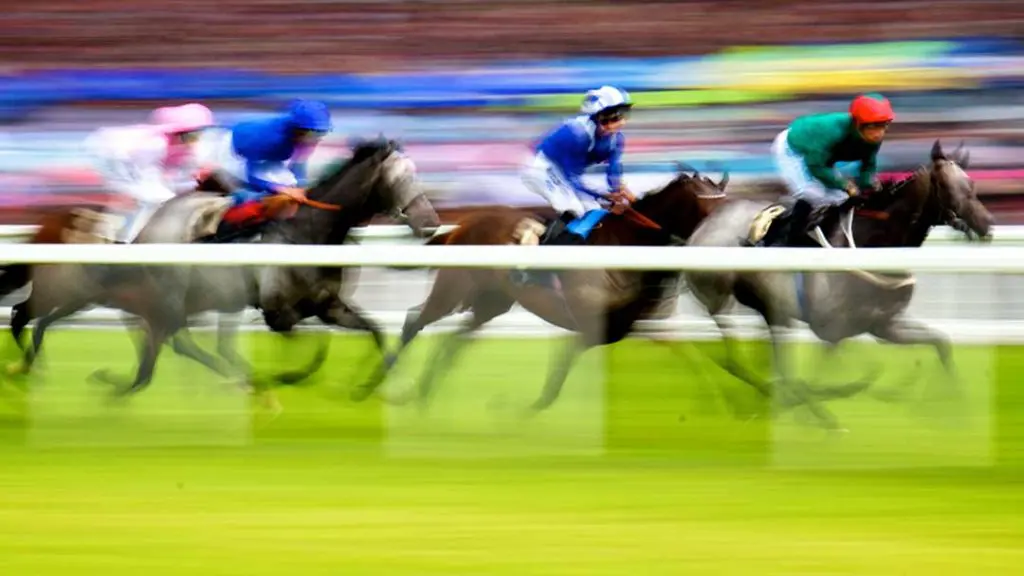
Different types of horse racing: flat and jumps
Flat races are run without obstacles and include racing on turf and all-weather surfaces. Jumps racing includes hurdle races and steeplechases. National Hunt Flat races, often called bumpers, sit within the jumps programme but are run without obstacles.
A clear racing section should make the meeting, race time and race type easy to identify. These details help you find the correct event, especially when several meetings have races starting close together.
Check the date as well as the time. An early market for tomorrow’s meeting can appear alongside today’s remaining races, and an ante-post market can refer to an event much further away.
Major meetings and international racing
A racing festival or one of the major races can attract additional markets, ante-post prices and race-specific promotions. However, the features available during a festival may differ from the bookmaker’s everyday racing service.
For international racing, inspect the settlement rules and market descriptions carefully. A market labelled “place” may not operate in the same way as the place portion of a UK each-way bet. Country-specific rules and pool-based markets can also differ from fixed-odds betting.
If your main interest is one racing circuit, prioritise clear coverage of that circuit over the total number of sports or countries advertised.
Reading the racecard
Useful racecards bring together the horse’s name, race conditions, recent form and relevant runner information. Depending on the site, you may also find jockey and trainer details, weights, draw positions and form comments.
Check whether information is current and whether non-runners are clearly marked. The racecard supports your understanding of the event; it does not remove uncertainty about the result.
A well-presented racecard is particularly useful on mobile, where crowded layouts can make it harder to compare runners or notice a change.
Types of Horse Racing Bets
Before you bet on horse racing, the racing section should explain what you are selecting and show the total stake before confirmation. Similar-looking markets can settle differently, so read the market name rather than relying on the horse’s name alone.
Win bets
Second place is not enough when you bet on a horse to win. A £5 win bet normally loses the full £5 if the horse finishes runner-up, even if it was beaten by a nose. A place or each-way bet may return something for that same finish.
Dead heats and any bookmaker concessions can change the settlement, so check the rules attached to the bet.
Each-way bets
An each-way bet consists of two equal parts: one backs the horse to win and the other backs it to finish in a qualifying place. A £5 each-way selection therefore costs £10 in total.
The place part uses a fraction of the win odds, with a specified number of finishing positions covered. Check both details before placing the bet.
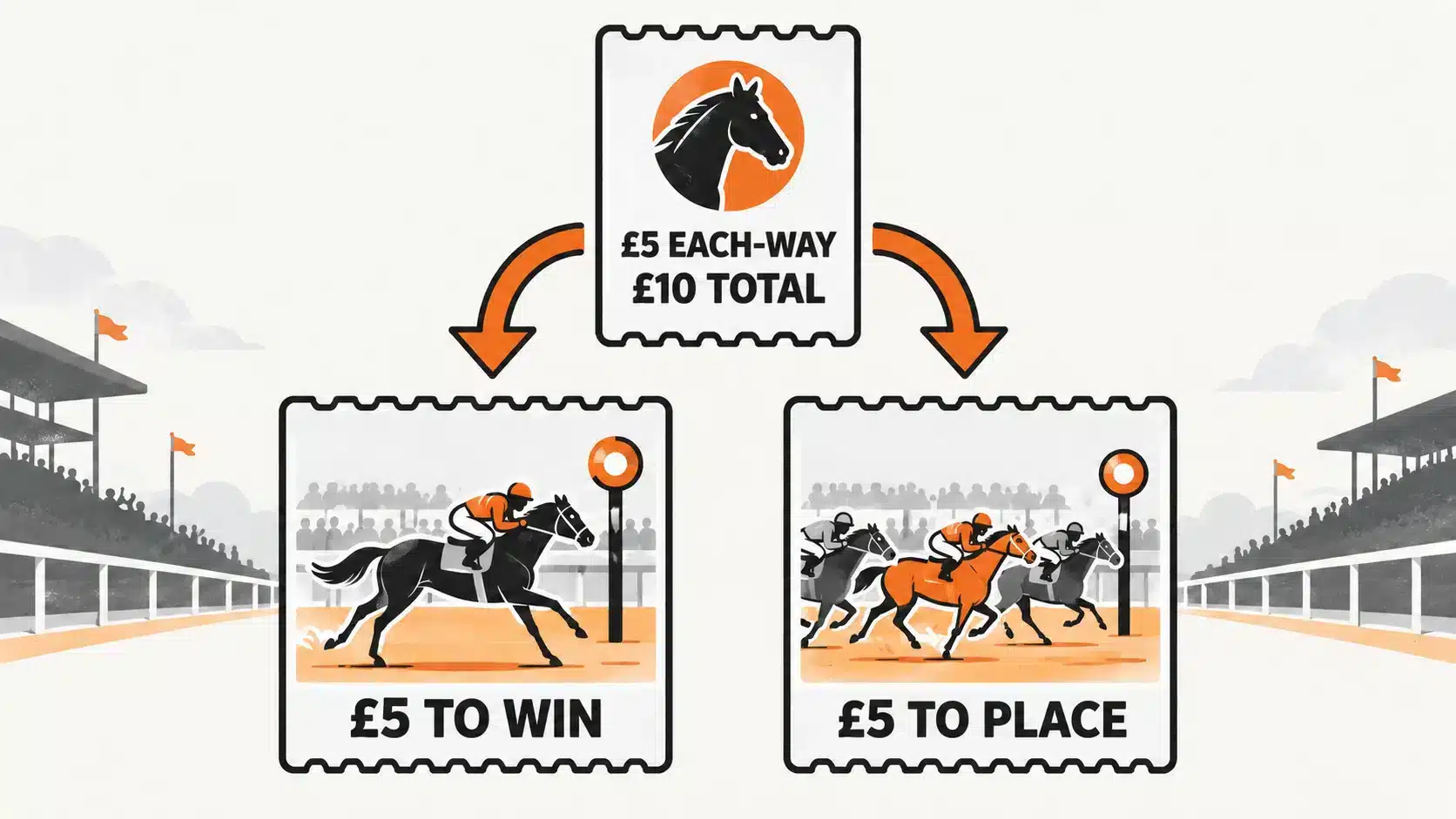
For illustration, assume £5 each-way at 10/1, with three places paid at one-fifth odds:
| Outcome | Win return | Place return | Total return |
|---|---|---|---|
| Horse wins | £55 | £15 | £70 |
| Horse finishes second or third | £0 | £15 | £15 |
| Horse finishes outside the paid places | £0 | £0 | £0 |
The total stake is £10. A £70 return means £60 profit; a £15 return means £5 profit. This example assumes no deductions or dead heat.
Place-only bets
Backing a horse to place covers it finishing within the positions specified for that betting market. There is no separate win portion.
The place-only price can differ from the price produced by applying an each-way fraction. Check the number of places and the actual odds shown. “To finish in the top two” and “to finish in the top three” are different bets.
Forecasts and tricasts
A straight forecast usually requires the first two horses in the correct order. A straight tricast extends this to the first three.
Reverse and combination versions cover additional finishing orders and therefore involve more individual bets. Check the total cost displayed in the bet slip, particularly when adding several horses.
Availability and payout methods vary. Some markets use fixed odds, while others settle using a declared dividend. Make sure you know which applies before confirming.
Multiples and accumulators
An accumulator combines selections into one bet, with each leg needing to succeed under the relevant rules for the full bet to win. Other racing multiple formats contain several separate bets and can have a much larger total stake than the unit stake suggests.
Each-way multiples add another layer of complexity. Read how the win and place parts combine, and check what happens if a selection is withdrawn.
A higher potential return also comes with more outcomes needing to go your way. The return shown in a bet slip is conditional, not an expected payout.
Horse Racing Odds and Best Odds Guaranteed
Horse racing odds can change between the first available prices and the start of the race. To compare the best horse racing odds available for a selection, use prices available at approximately the same time.
A price seen earlier in the day may no longer be available by the time you open an account or add the selection to your bet slip.
Fractional and decimal odds
Fractional odds describe the profit relative to the stake. At 4/1, a successful £10 win bet produces £40 profit and returns £50 including the stake, before any applicable adjustment.
Decimal odds include the returned stake. The equivalent price is 5.00, so the same calculation is £10 multiplied by 5.00.
Choose the display you find easiest to read. Changing the format changes how the odds appear, not their value. Decimal odds of 5.00 imply a 20% probability of a horse winning (1 divided by 5). That is the probability implied by the price, not an independent forecast of its chance.
Fixed odds and starting price
If your bet is accepted at 4/1, that is the fixed price recorded on your receipt. Select SP instead and you leave the price open until the official starting price is returned for the race. It could be higher or lower than the 4/1 you saw earlier.
The accepted price is still subject to settlement adjustments, such as a Rule 4 deduction. Best Odds Guaranteed, where applicable, is a separate concession explained below.
What does Best Odds Guaranteed mean?
Best Odds Guaranteed is a concession that can pay an eligible fixed-odds bet at the starting price if that price is higher than the one taken. If you take 4/1 and the qualifying selection wins at an SP of 6/1, the higher price can apply under the offer’s terms.
Check when eligibility begins, which races qualify and whether the concession applies to your account and market. Do not assume a badge on one race applies to every bet on the website.
Best Odds Guaranteed also does not mean the bookmaker offers the highest price across all betting sites. It describes a specific settlement concession.
Each-Way Terms and Extra Places
For racing punters who prefer each-way bets, the place terms deserve as much attention as the headline odds.
An extra place can extend the range of finishing positions that qualify for the place part. However, compare it alongside the odds and fraction offered. More places do not automatically make every aspect of the bet better.
Suppose the same horse is offered at these two sets of terms:
| Market | Win odds | Place fraction | Places |
|---|---|---|---|
| A | 10/1 | One-fifth | Three |
| B | 8/1 | One-fifth | Four |
Fourth place is where the extra place in Market B makes a difference: its place part pays, while Market A’s loses. But if the horse finishes in the first three, a £5 place stake returns £13 at B’s terms against £15 at A’s. These figures include the place stake and assume no deductions or dead heat; the win part of an each-way bet is settled separately.
Check whether an enhanced market is separate from the standard win/each-way market. The selected market should be clear on the bet slip and the accepted bet receipt.
Runner changes can also affect settlement. Do not assume that the place terms displayed when browsing will always remain unaffected by withdrawals; inspect the rules that govern the accepted bet.
Non-Runners, Rule 4 and Dead Heats
A racing bet can settle differently from the initial potential return if a horse is withdrawn or runners share a finishing position. These are useful rules to understand before they affect a bet.
What happens if your horse becomes a non-runner?
For standard day-of-race markets, a bet on a non-runner will generally be void, with the cash stake returned. Ante-post markets are different: unless a relevant concession applies, the stake can be lost if the horse does not take part.
Check how a void selection affects a multiple, and distinguish cash-stake refunds from the treatment of promotional stakes. An offer may have separate rules for a void qualifying bet.
What is Rule 4?
Rule 4 can reduce winnings on remaining runners when a horse is withdrawn after a bet was placed. The adjustment reflects the changed field, and its size depends on the withdrawn runner’s price under the applicable rules.
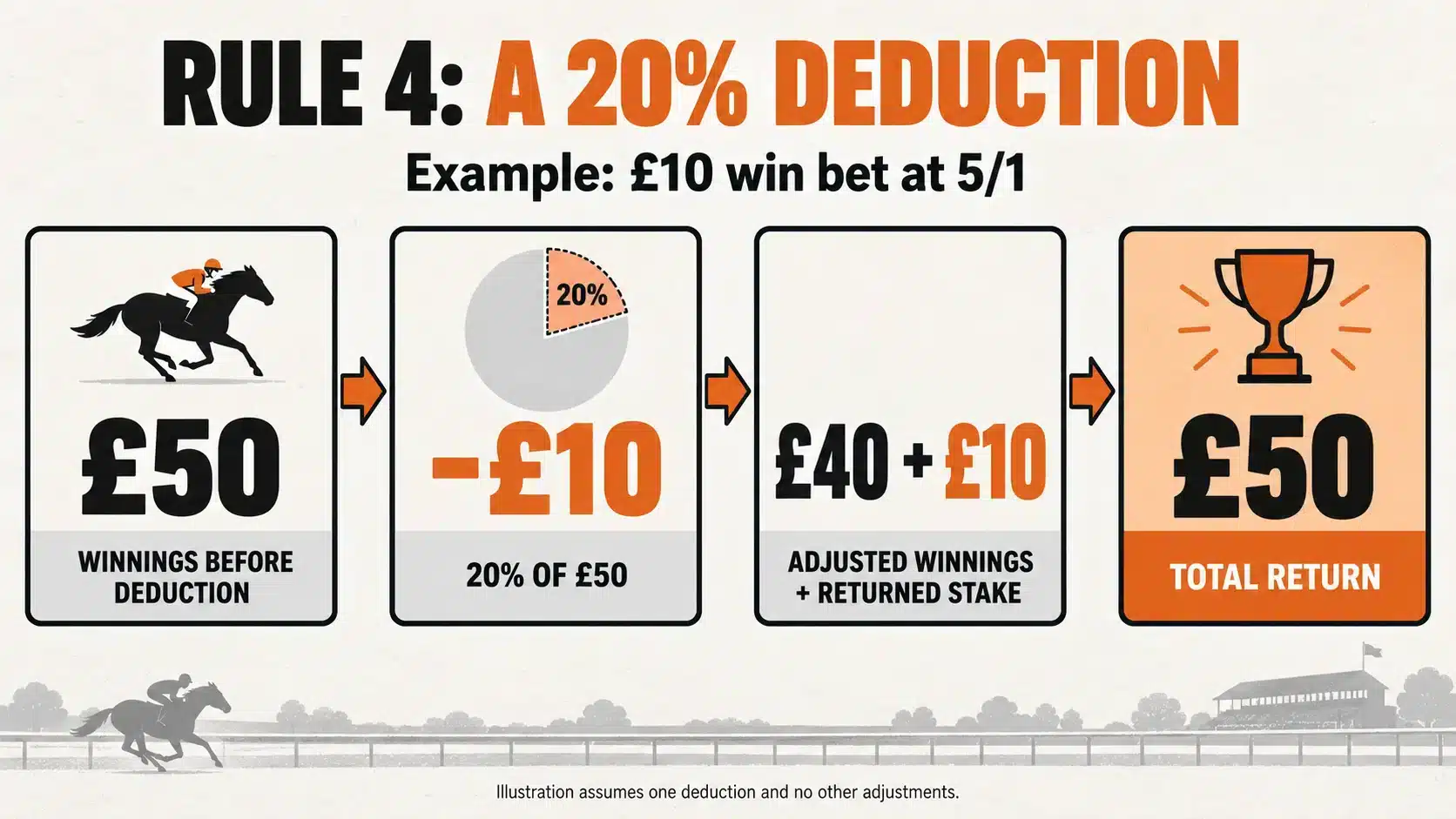
For a simple illustration, take a £10 win bet at 5/1. Before adjustments, the profit would be £50. If a 20% deduction applies to those winnings, the profit becomes £40 and the total return is £50 including the £10 stake.
This example assumes a single deduction and no other adjustment. The bookmaker’s published rules determine the actual settlement.
What happens in a dead heat?
A dead heat occurs when runners share a finishing position. Where standard dead-heat rules apply, the relevant stake is divided according to the number of tied selections and the available winning positions.
For a straightforward two-horse dead heat for first place, a £10 win bet at 4/1 would normally settle with £5 at the full odds, producing a £25 return. This is different from receiving the full £50 return for an outright winner.
Place-market dead heats can involve a different proportion. Check the relevant settlement calculation rather than assuming every tie means half the payout. Betting rules and dead-heat provisions.
Ante-Post Betting and Non-Runner No Bet
Ante-post markets let you back a horse before the normal race-day market, sometimes well ahead of the event. They carry additional uncertainty about whether the horse will participate.
A horse’s planned target can change, so an entry or an available price is not a guarantee that it will run. Read the market classification before treating an early price like an ordinary day-of-race bet.
Non-Runner No Bet, often abbreviated to NRNB, is a concession that can return the stake if the horse does not run. Check that it applies to the specific market and to the time your bet was placed. A later announcement of NRNB does not necessarily change an earlier ante-post bet.
For comparisons, look at price and withdrawal protection together. A larger quoted price with a different non-runner condition is not the same product as a smaller price with NRNB.
Horse Racing Betting Offers: What to Check
When comparing the best horse racing betting offers for your intended stake, the headline value is only part of the offer. Before choosing a site on that basis, read the steps required to qualify and the restrictions on using the reward.
A practical comparison should answer these questions:
- Is the offer available to new customers, existing customers or selected accounts?
- Is registration with a code or an opt-in required?
- What cash stake and minimum odds apply?
- Which races, markets or bet types qualify?
- When must the qualifying bet be placed and settled?
- When does the reward expire?
- Are particular payment methods excluded?
- Is the reward cash, a free bet or another form of credit?
Keep the qualifying bet and the reward separate in your comparison. They can have different minimum odds, eligible markets and expiry rules.
Free bets and stake treatment
Check whether the promotional stake is returned with winnings. A £10 free bet offer can produce a different return from a £10 cash bet at the same odds.
Also check whether a free bet must be used in one go or can be split. An offer that expires quickly may be unsuitable if you only follow occasional meetings.
Refunds and racing concessions
A promotion described as money back may return a free bet rather than withdrawable cash. Similar labels can cover different triggers, limits and exclusions.
Read the full conditions for any faller insurance, finishing-position promotion or other racing concession. Do not assume that a general promotional banner applies to every runner, every race or every stake.
Choose a site for its overall suitability. A promotion should not require you to increase spending beyond the amount you had already planned.
Horse Racing Betting Sites with Live Streaming
Watching horse racing live through a bookmaker can be convenient if the stream and market are on the same page. Coverage and access requirements vary, so check the particular meeting.
Look for clear information about whether viewing requires a funded account, a qualifying bet or another condition. Access to one stream does not establish access to all races.
Live pictures may be delayed relative to the event. Keep that in mind when looking at in-play prices, which may change before an incident appears on your screen.
Comparing horse racing betting apps
When choosing a betting app for horse racing, focus on routine tasks: finding a meeting, reading the racecard, checking place terms and reviewing an accepted bet.
A useful mobile layout should make the race time, selected market and total stake easy to see. Small screens make clarity especially important for each-way bets and multiples.
You may prefer a mobile website to an app. Check whether the features you need work in your chosen browser and whether the layout remains usable when you switch between racecards and account information.
Cash out and in-play availability
A cash-out button visible before the race does not mean you will be able to use it later. The offer may become unavailable during the event, and some bets do not qualify at all. Do not place a bet on the assumption that you can close it whenever you choose.
Look at the amount you would actually receive. If a full cash out of £6 is completed on a £10 cash bet, you have lost £4. The bet is then settled, so a later win by your horse does not bring another payment. Check that the cash out has been confirmed rather than relying on a price that was briefly displayed.
Payments and Withdrawals
Payment convenience is part of comparing horse racing bookmakers in the UK. Check the methods available to your account, the minimum deposit and the withdrawal conditions before funding it.
A familiar payment logo does not necessarily mean identical conditions across sites. Deposits and withdrawals can have different limits, and an available deposit method may not support withdrawals in the same way.
Look for an explanation of processing times and distinguish the bookmaker’s review stage from the payment provider’s transfer time. Avoid interpreting an advertised timeframe as a guarantee for every withdrawal.
Account verification can affect access to services and payments. Use accurate account details, read document requests carefully and check that you are communicating through the operator’s official support channels. The Gambling Commission says businesses must not make withdrawal conditional on age or identity information they could reasonably have requested earlier. See its identity verification guidance.
If an issue occurs, keep the bet reference, payment reference and relevant correspondence. Clear records make it easier to explain what needs checking.
Horse racing betting is for adults aged 18 and over. Read our responsible gambling guide for support and account-control options. Set a budget you can afford to lose, use account limits where appropriate and avoid chasing losses.
Frequently Asked Questions
What are the best horse racing betting sites?
The best choice depends on the races and features you use. Compare coverage, prices, each-way conditions, streaming, mobile usability and payment terms. No bookmaker necessarily offers the strongest combination for every race.
Do all sports betting sites offer horse racing?
Do not assume they do. Before you bet on horses, check the current racing section and available meetings. Even where racing is offered, the selection of countries, markets and features can differ.
Is a £5 each-way bet a £5 total stake?
No. It normally means £5 on the win part and £5 on the place part, for a £10 total stake. Always review the total on the bet slip before confirming.
Are extra places always better?
An additional paid position can be useful, but compare it with the win odds and place fraction. A market with more places may offer a lower price or different conditions.
Does Best Odds Guaranteed mean the highest odds anywhere?
No. It generally concerns settlement against the starting price on eligible bets. It does not promise that the bookmaker’s price is higher than every competitor’s.
Can I watch horse racing without placing a bet?
That depends on the service and its viewing requirements. Check the streaming terms for the meeting rather than assuming that all streams require a bet or that all are freely available.
Are ante-post bets refunded if the horse does not run?
Usually not unless a relevant concession, such as Non-Runner No Bet, applies. Read the conditions attached to the market when the bet is accepted.
Why was my return lower than the bet slip initially showed?
Possible reasons include a Rule 4 deduction or dead-heat settlement. Check the accepted bet, official result and applicable rules. Ask support for a calculation if the adjustment is unclear.
Do I need an app to use a horse racing betting site?
Often a mobile website is available, but features vary. Check that your preferred device and browser support the racecards, account functions and streaming service you intend to use.
What should I check before confirming a bet?
Before betting on horse racing online, review the meeting, race time, horse, market, odds and total stake. For each-way selections, also check the place fraction and number of paid places. Keep the accepted bet receipt for reference.

Daniel is a content creator at Mr Win and has worked in the iGaming industry since 2012. With more than a decade of experience reviewing casino operators and bonuses, he focuses on safe play, licensing standards, and helping players find fair gaming sites.
Fact checked by: Greg – Casino expert. Last fact-checked: October 7, 2026.