
A tied T20 match can still produce a winner after a Super Over. A match-winner bet may include that tie-break while a player-runs bet excludes it. When comparing cricket betting sites, the price only tells part of the story.
Use the same fixture to compare the available markets, odds and rain rules. Our UK betting sites guide covers the wider sports comparison.
Cricket betting sites for UK customers
The operators below list cricket in their sports coverage. Check your fixture for available markets and read the offer terms before depositing.
Disclosure: Mr Win may receive compensation when you sign up through links on this site. This comes at no cost to you and does not affect the products, services, or offers you receive.
-
Sign up bonusBet £10 and Get £40 in Free Bets 18+. New customers only. Opt in to the Sports Welcome Offer, deposit £10+ and place a qualifying £10 sports bet within 7 days of registration. Minimum odds 1/1 (2.0); each-way bets require £10 each way (£20 total). After settlement, receive 4 × £10 free bets: 2 for football accumulators (4+ selections) and 2 for sports multiples (2+ selections). Free bets expire after 7 days; free-bet stakes are not returned. Excludes virtual sports, esports and non-UK/Irish horse racing. Free bets, profit/odds boosts, void, cashed-out, partially cashed-out and system bets do not qualify. Full terms apply.Current welcome offer: Bet £10, Get £40 Best Odds Guaranteed on horse racing Bet builder, in play, and cash out featuresBetUKJoin Now
-
Sign up bonus100% Sports Welcome Bonus up to £50 18+. New customers: select the Sports Welcome Bonus at sign-up and make your first deposit to receive a 100% bonus up to £50. Wager the bonus 10x within 30 days. Minimum odds: 1/1 (2.00) for singles and 1/2 (1.50) per accumulator selection. Cash funds are used first. Withdrawing before completion forfeits the bonus and its winnings. Skrill and Neteller deposits are excluded. Virtual Sports, voided, cancelled, drawn, cashed-out and Free Bet wagers do not count. Only the first settled bet on the same event counts. Cannot be combined with other promotions. Full terms apply.Wide sports betting markets Competitive odds & promotions Good customer service10betJoin Now


How to compare the best cricket betting sites
An Ashes follower and someone watching franchise T20 cricket need different things from a sportsbook. For Test matches, first-innings markets and a clearly priced draw may matter most. For IPL betting, you might be looking for a named batter’s runs or a particular innings total. A tournament-winner price alone tells you little about either.
Open a fixture from your competition before choosing a cricket bookmaker. Look at the actual market list, then compare it with the same match elsewhere. Separate men’s and women’s competitions, and distinguish a series winner from the next match winner. For a cricket fan following one league closely, that fixture-level detail is more useful than the total number of sports listed.
- Market scope: does the bet cover one team, both teams, one innings or the whole match?
- Settlement: can you find the rain, tie and player-participation rules from the market?
- Price: compare identical selections. A higher price for a different runs line is a different bet.
- Mobile use: try moving from the scorecard to the market and back. You should be able to review the selection, odds and stake comfortably before confirming.
Licensing comes before these comparisons. Use the Gambling Commission register to check the business behind the site, its web address and permitted activities. The licence entry should match the operator and website you intend to use.
Test, ODI, T20 and The Hundred
A side blocking out the last hour of a Test may be doing exactly what it needs to save the match. That approach will not complete a limited-overs chase, where the remaining balls put a limit on the time available.
| Format | Basic structure | Detail to check on the bet |
|---|---|---|
| Test cricket | Up to two innings per team, scheduled over several days | First innings or whole match; draw treatment |
| ODI cricket | One innings per team, normally up to 50 overs | Revised overs and the result used after rain |
| T20 | One innings per team, normally up to 20 overs | Whether a Super Over counts |
| The Hundred | Up to 100 balls per innings | The specified ball block or innings, rather than assuming a T20 market |
The International Cricket Council’s format guide explains the international formats; The Hundred has its own playing rules. Rain can shorten an allocation, and an innings can finish earlier when a team is all out or reaches its target.
Match betting: the draw, a tie and a Super Over
A Test draw does not mean equal scores
Imagine the final evening of a Test. The chasing side is still 80 runs short with three wickets left when play ends. If no result has been reached, the match is drawn. Those last three wickets have kept the chasing side in the game.
A tie is different: the scores are equal when all innings have been completed. MCC’s Laws of Cricket distinguish those results. On a three-way market offering each team and the draw, the draw selection wins on a drawn result, provided the market’s completion conditions have been met. A market labelled “draw no bet” needs its own settlement terms; do not treat a tie as another word for a draw.
What happens after a tied T20 match?
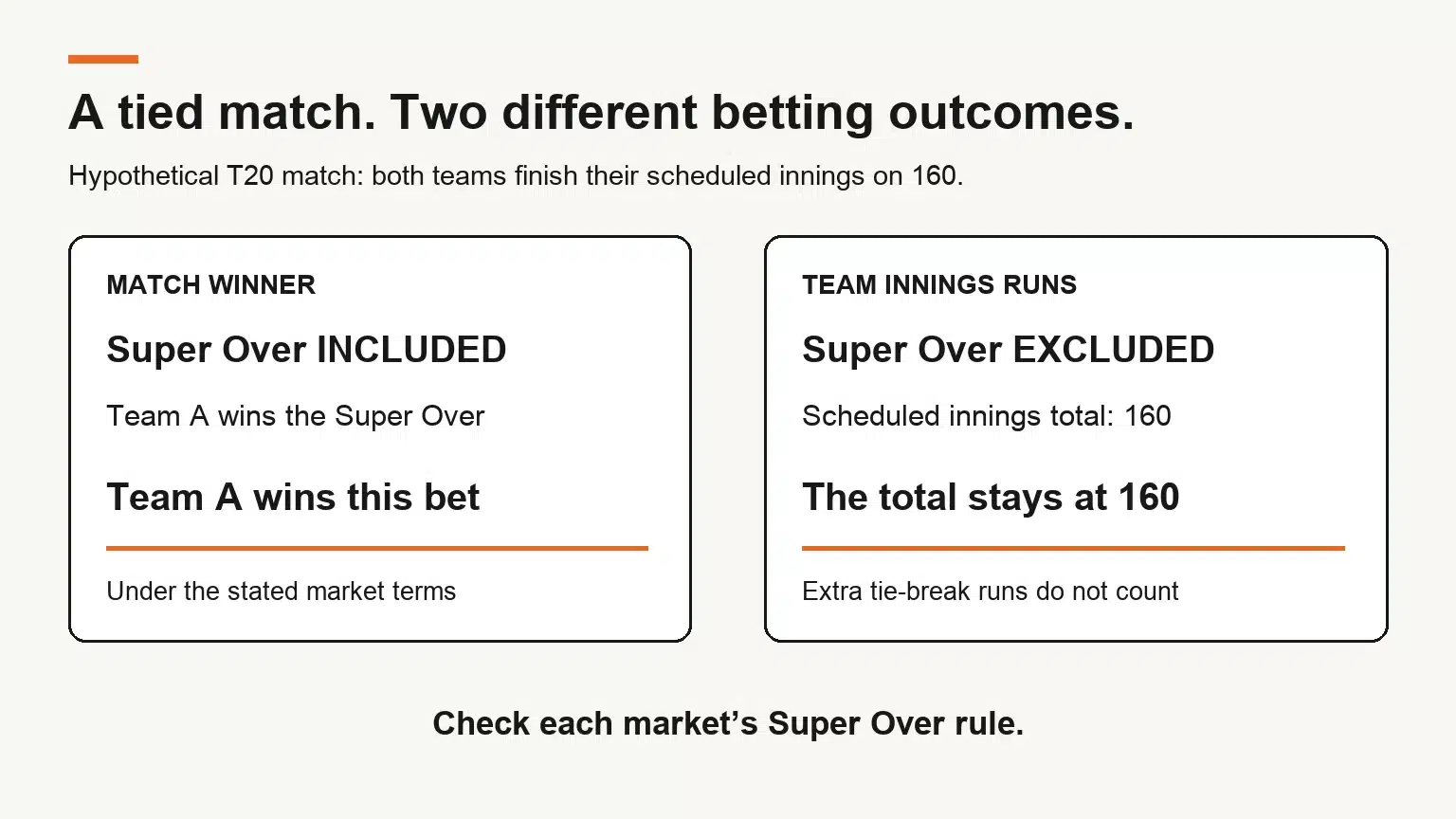
Suppose both teams finish their scheduled innings on 160, then one wins a Super Over. A match-winner market that includes the tie-break can pay out on that winner. It does not follow that the extra runs or sixes count towards a separate innings or player bet.
Find the Super Over clause for each selection. The competition decides how to break a tie; the bookmaker defines the period covered by its market. The ICC men’s T20I playing conditions, for example, provide for a Super Over after a tie, subject to the conditions for completing it. Other competitions and formats must be checked separately.
Cricket betting markets: runs, wickets and innings
The examples below use invented scores and prices. They explain settlement rather than predict a match.
Read overs as balls, not decimals
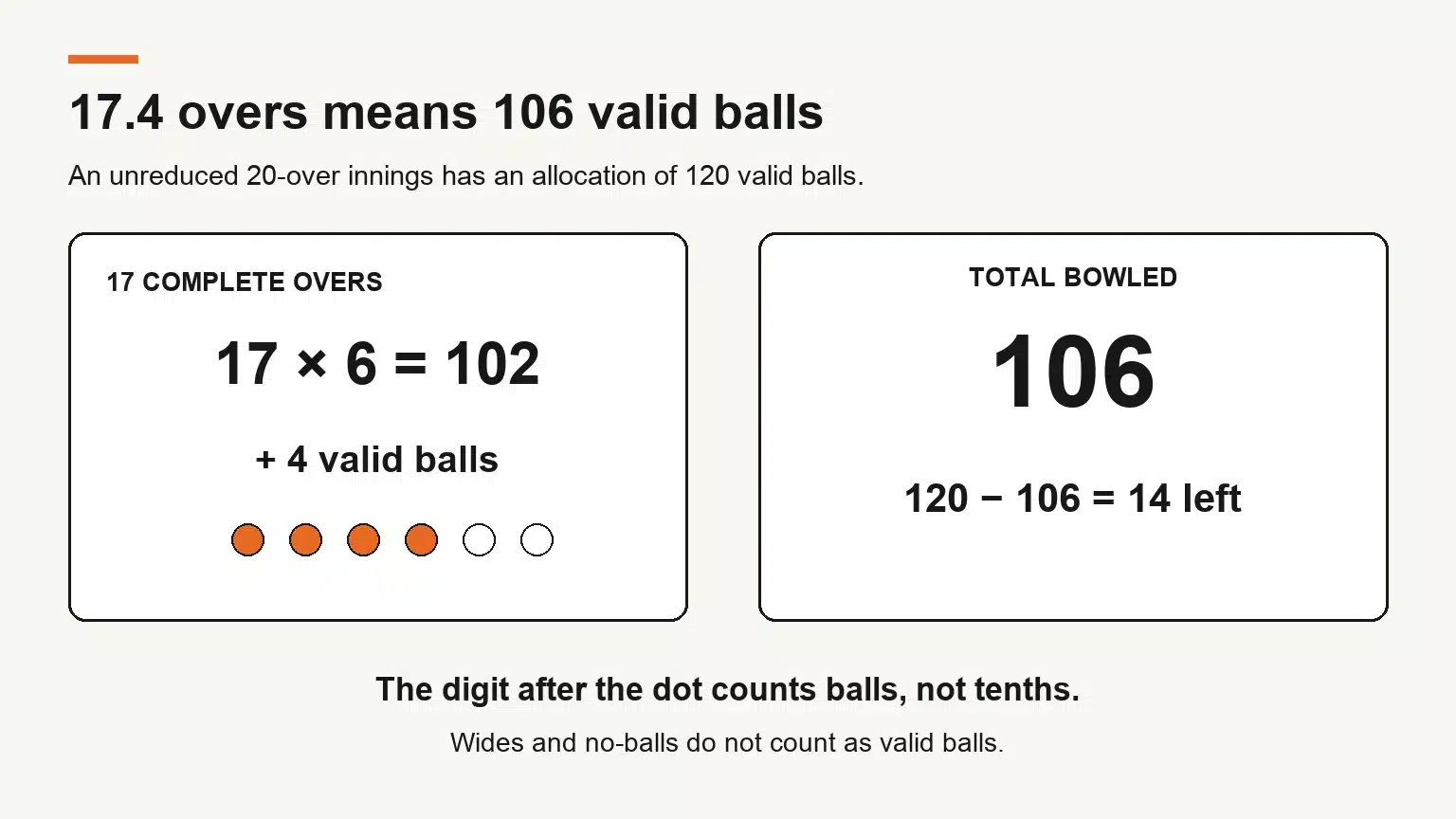
At 17.4 overs, a team has faced 17 complete six-ball overs and four further valid balls: 106 in all. In an unreduced 20-over innings, that leaves 14 valid balls. The “.4” is not four-tenths of an over.
Wides and no-balls do not use up one of those six valid balls. This matters when reading a live score beside a next-over market: the over can contain more than six deliveries.
Team runs and a batter’s score
A score of 147/6 means 147 runs for six wickets. For a completed innings covered by the market, that clears a team total of over 146.5. A bet on one batter to score over 30.5 still needs that player to reach 31, however well the rest of the side bats.
Team totals include extras; an individual batter’s score does not. Also look for “first innings” in Test cricket markets. Adding a player’s second-innings runs to a first-innings selection changes the question the bet was asking.
Top batsman and top bowler
“Top batsman” or “top batter” can refer to one team or both sides. Two players finishing on 52 may share first place, so the dead-heat clause matters even when your selection has the joint-highest score.
For example, under a two-way dead-heat rule that halves the winning stake, a £10 bet at decimal odds of 5.00 returns £25. Only £5 is settled at 5.00; the other £5 loses. That leaves £15 profit on the original £10 stake.
For top bowler, read the tie-break as well as the wicket count. A market can use runs conceded to separate bowlers who take the same number of wickets. Equal wickets therefore need not produce the same settlement as equal runs in a top-batter market.
A comfortable chase can leave a batter waiting in the pavilion for an innings that never comes. Published rules can treat that differently for a top-scorer selection and an individual runs bet. Check what happens if your player is in the XI but does not bat.
Bet builders and cricket tournament winners
England win, but your chosen batter falls for 49. A bet builder pairing an England victory with that batter to score at least 50 still loses. If the player does not take part and that leg is void, check the builder’s own void-leg rule. The treatment of a separate bet on the batter may not apply to the combination.
An outright selection stays open beyond the next fixture. Winning an opening match is only a step towards winning the tournament. Confirm the competition, edition and whether the market covers a group, a series or the eventual champion. They can all feature the same team at different prices.
Rain, DLS and unfinished cricket bets
The covers coming on do not tell you what happens to every bet. Start with the affected innings and the market on your receipt.
In limited-overs cricket, Duckworth–Lewis–Stern (DLS) can set a revised target after interruptions. Use the officially announced figure. If the target for a revised innings is 151, finishing that innings on 150 leaves the scores level under DLS. The target is one run above par. A live par score earlier in the chase refers to that stage of the innings, so it should not be confused with the final target.
A bookmaker may settle match betting on the official weather-adjusted result while applying minimum-overs conditions to another market. Those thresholds are market-specific. A rule for innings runs cannot safely be carried over to a batter’s score or a winning margin.
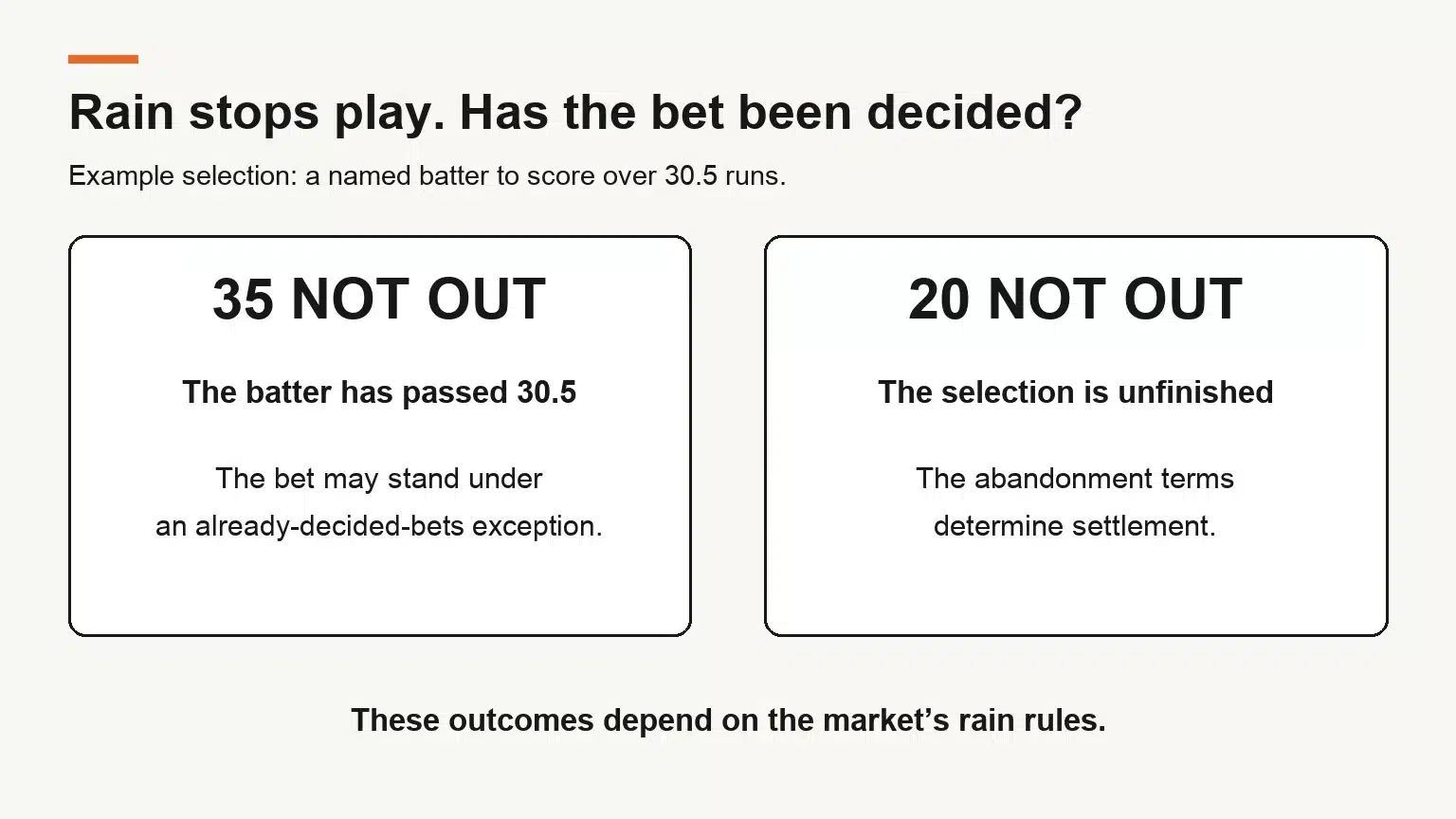
Rain ends play with your batter 35 not out. You backed over 30.5, so no more runs are needed; the bet can stand if the rain rules preserve outcomes already decided. A score of 20 not out leaves that selection unfinished, with settlement dependent on the abandonment terms.
At 121/2 after 14 overs, a side chasing 121 has won its 20-over match. The remaining six overs are unnecessary. A “natural conclusion” exception can let bets stand despite a minimum-overs requirement; the same may apply to a side bowled out. Keep the receipt for any query about the line you took.
Compare cricket odds on the same selection
The best odds comparison starts with matching the bet. Over 159.5 and over 160.5 team runs are not interchangeable: a final total of 160 wins the first and loses the second.
With the same line and settlement terms, a £12 cash bet at 2.50 returns £30 if it wins, including the stake, for £18 profit. At 2.40, the same stake returns £28.80. Our betting odds guide explains decimal and fractional prices in more detail.
Live cricket betting, streams and cash out
A wicket or a boundary can change the position while you are reviewing an in-play bet. Check the accepted odds and selection on the receipt. For a live total, establish whether the displayed line covers the final innings score or only the remaining play.
If you use betting apps to watch a match as well as follow the score, check streaming access for that fixture. A cricket listing in the betting menu does not establish viewing rights. A broadcast can also lag behind play, so it should not be treated as a real-time view of what the bookmaker knows.
Cash out is an offer to settle early, when available. A price you can see between deliveries may no longer be available after the next ball. Do not choose a stake on the assumption that a particular cash-out amount will remain open later.
Cricket free bets and welcome offers
A welcome offer is only useful for your intended cricket bet if its terms allow that market. Check both stages: what qualifies for the reward and where the reward can be spent. A qualifying bet on cricket does not itself establish that every subsequent bet type is eligible.
Before making a first deposit, read the minimum odds and stake, expiry and any excluded payment methods. If a bonus code or opt-in is required, find that instruction before placing the qualifying bet. A headline amount alone cannot tell you whether the offer fits.
A £10 free bet at 4/1 pays £40 when it wins if the promotional stake is not returned. The equivalent cash bet returns £50. The missing £10 is the stake, not a change in the odds; check how the particular offer handles it.
Before depositing, find out which verification documents you may need and whether you can withdraw to your chosen payment method. Be careful with the word “processed”: it may mean the bookmaker has approved the withdrawal, with the bank transfer still to follow.
Set a spending limit before you bet on cricket and keep it separate from money needed for bills. A long match or another day’s play is not a reason to raise it.
Cricket betting sites: common questions
How do I choose the best cricket betting site?
If you mainly follow the IPL, open an IPL fixture on each licensed site you are considering. A price for the tournament winner is little use when you want to back an opener to score 30 runs. Find that player market, compare the odds and read what happens to the bet if rain cuts the innings short or the match goes to a Super Over.
Does a Super Over count towards cricket bets?
It depends on the market. Match-winner terms may include it while innings totals and player runs exclude it. Read the clause for the selection you are placing, even if several bets are on the same match.
Are cricket bets refunded when it rains?
Rain does not automatically void every bet. The official result, the market’s completion requirements and whether the selection was already decided can all matter. Check the rain rule against the exact market on your receipt.
What does 17.4 overs mean?
Read 17.4 as 17 overs and four valid balls: 106 valid balls have been bowled. The next valid ball takes the display to 17.5, then the following one completes the eighteenth over. The digits after the dot count balls, not tenths.
Can a Test match be drawn with different scores?
Yes. A team can finish the final day 80 runs short of its target with three wickets left and still save the Test. Provided no result has been reached when the match ends, it is a draw. A tie requires equal scores with all innings completed.

Daniel is a content creator at Mr Win and has worked in the iGaming industry since 2012. With more than a decade of experience reviewing casino operators and bonuses, he focuses on safe play, licensing standards, and helping players find fair gaming sites.
Fact checked by: Greg – Casino expert. Last fact-checked: October 8, 2026.