
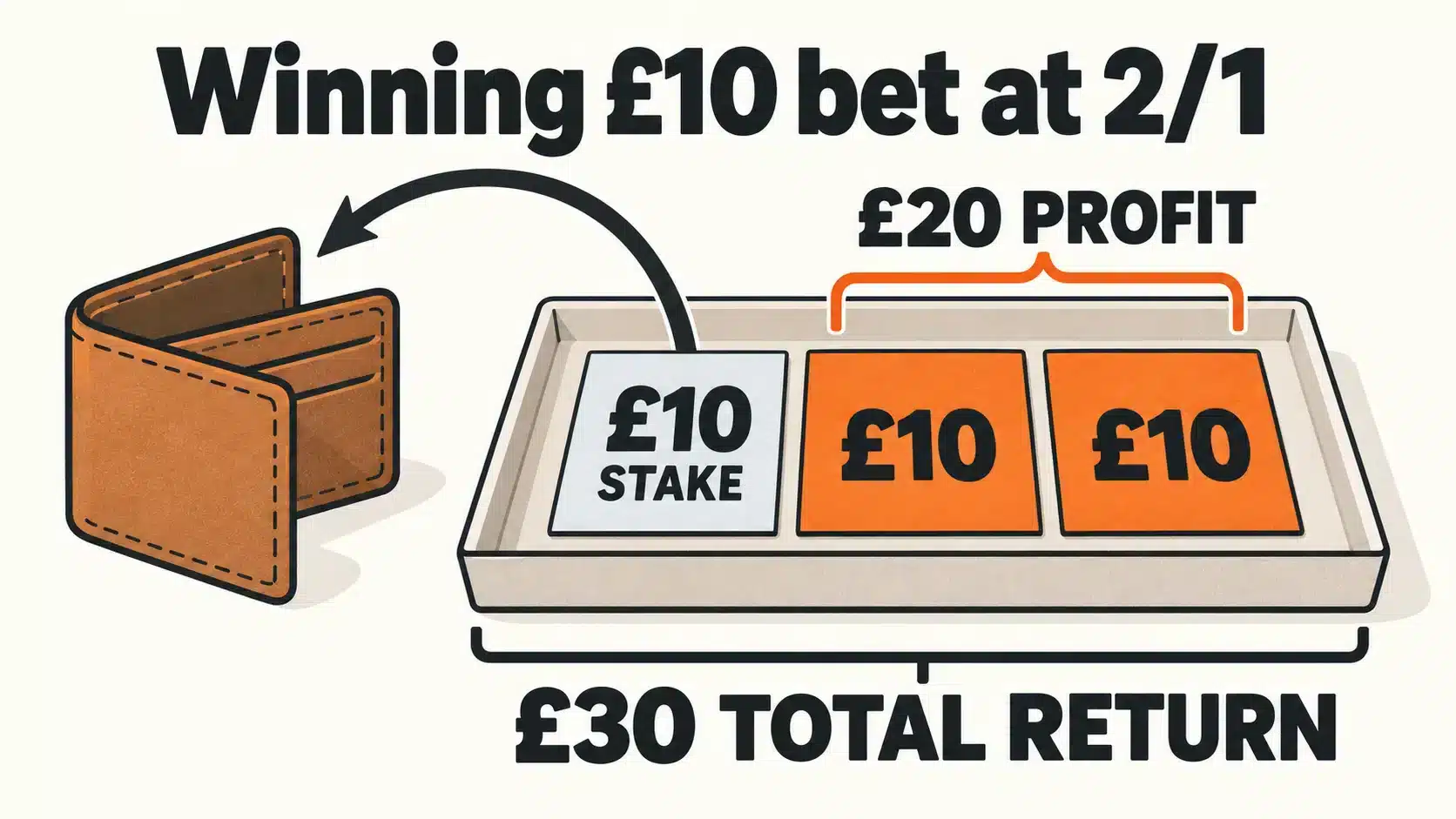
A winning £10 bet at 2/1 returns £30: £20 profit and the original £10 stake. Switch the display to decimal odds and the price becomes 3.00. The payout stays the same. What changes is where the stake appears in the calculation.
That distinction is the starting point for reading betting odds. The numbers tell you what a winning bet would pay, and they can be converted into an implied probability. They cannot tell you whether the selection will win.
For the wider comparison of bookmakers and account features, see our UK betting sites guide.
How do betting odds work?
On a bet slip, the stake is the money you put at risk. The total return includes that stake if the bet wins; profit is what remains after subtracting it. A losing £10 cash bet returns nothing, leaving a £10 loss.
Watch the wording beside a payout figure. “Potential winnings” can be unclear unless the display explains whether your stake is included. A £30 return from £10 staked does not leave you £30 better off.
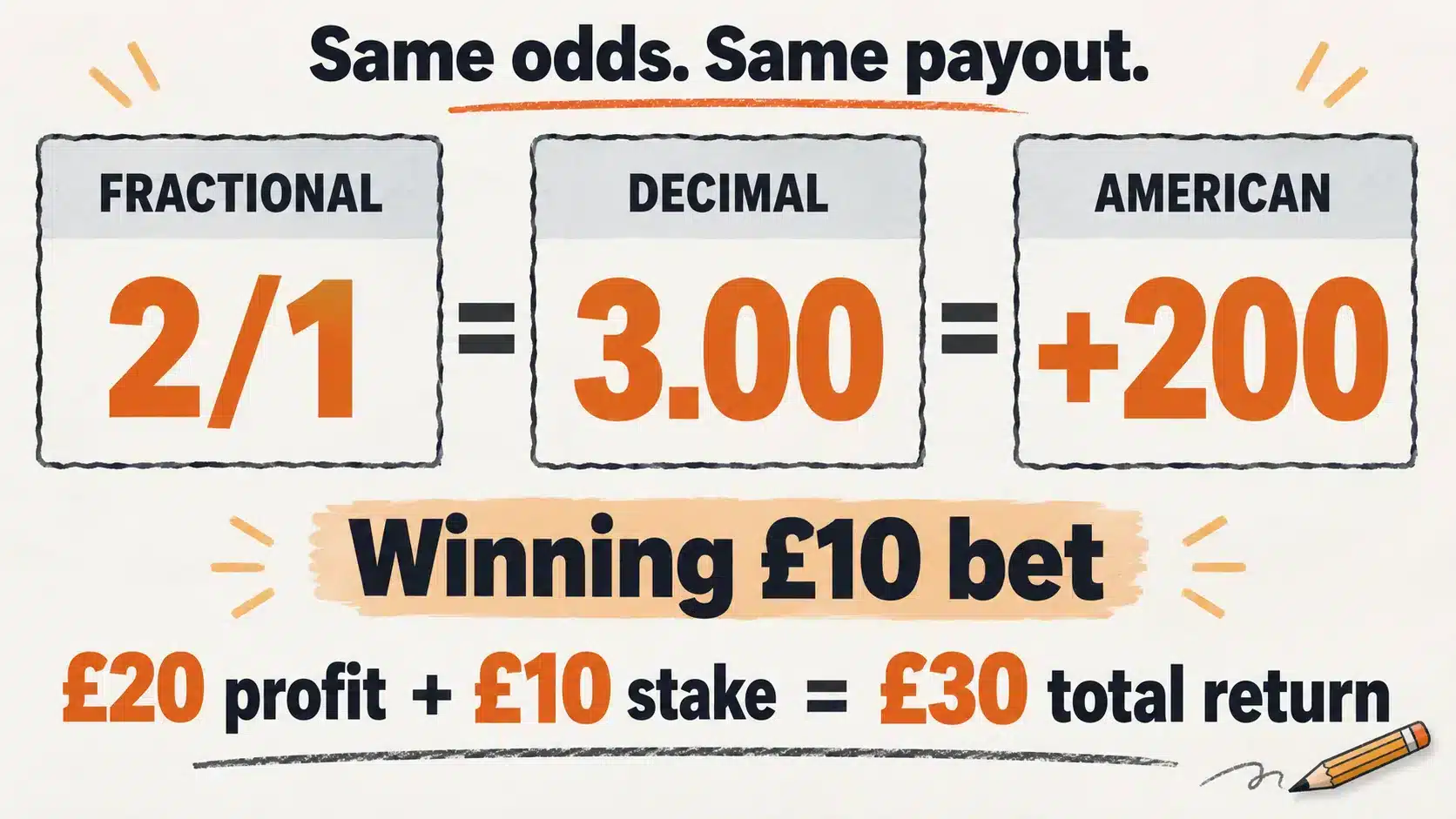
Fractional, decimal and American odds express the same relationship between stake and profit. For example, 2/1, 3.00 and +200 are equivalent prices. Changing the format doesn’t improve the odds or change the outcome.
The examples below use cash stakes and winning bets settled at the quoted price, before deductions or commission. Promotional credits can have different payout rules.
Fractional odds: what does 5/1 pay?
At 5/1, there is £5 profit for every £1 staked on a winner. The £1 comes back as well, making a £6 return. Read the fraction as a ratio of profit to stake, rather than a suggested amount to bet.
That becomes useful with a price such as 7/2. The two does not mean you must stake £2: a £1 stake would produce £3.50 profit if it won. For a £10 stake, the calculation is £10 × 7 ÷ 2 = £35 profit. Add the £10 stake and the return is £45.
The general rule is profit = stake × first number ÷ second number. It works for fractional odds on either side of evens.
Odds-on, odds-against and evens
A price of 1/2 is odds-on: the potential profit is smaller than the amount staked. A winning £10 bet at that price returns £15, of which £5 is profit. Odds-on carries an implied probability above 50%, but a selection at that price can still lose.
At evens, or 1/1, the potential profit equals the stake. A £10 winner returns £20. Anything above evens, such as 2/1, is odds-against, with potential profit greater than the stake.
A favourite need not be odds-on. “Favourite” identifies the selection with the shortest price in the market; in a field with several possible winners, that price could be 3/1. An underdog has longer odds than the favourite. These labels describe how the selections are priced.
Decimal odds include your stake
The £45 paid on a winning £10 bet at 4.50 is the whole payout. Adding another £10 would count the stake twice. You can see this directly in the multiplication, £10 × 4.50 = £45, which gives the same return as 7/2.
To calculate a payout at any decimal price, multiply the stake by the odds. Subtract the stake from that result if you want the profit. A decimal price below 2.00 still pays a profit on a winner: £10 at 1.50 returns £15, leaving £5 profit.
Converting fractional odds to decimal odds
The extra one in a decimal price accounts for the stake. Divide 7 by 2 and you get 3.50, the profit per £1 at 7/2. Add one for the returned £1 and you arrive at 4.50.
Decimal odds = (first number ÷ second number) + 1
To convert decimal odds back to a fraction, remove that one first. A price of 2.50 leaves 1.50, which is 3/2 in fractional form.
Betting odds conversion table
Each row below shows a winning £10 cash bet. The profit and total return are separate columns so you can compare the figures without counting the stake twice.
| Fractional odds | Decimal odds | Profit | Total return | Implied probability |
|---|---|---|---|---|
| 1/2 | 1.50 | £5 | £15 | 66.67% |
| 1/1 | 2.00 | £10 | £20 | 50.00% |
| 6/5 | 2.20 | £12 | £22 | 45.45% |
| 2/1 | 3.00 | £20 | £30 | 33.33% |
| 7/2 | 4.50 | £35 | £45 | 22.22% |
| 9/2 | 5.50 | £45 | £55 | 18.18% |
Implied probabilities are rounded to two decimal places.
Rounding the odds themselves needs more care. At 8/13, a winning £13 bet returns exactly £21. The equivalent decimal expansion begins 1.615384… Shorten it to 1.62 and multiplying by £13 gives £21.06. That 6p difference is a rounding effect, so an approximate conversion should not replace the original price when checking a payout.
American odds: reading the plus and minus signs
American odds use 100 as a reference amount. The sign tells you which side of the calculation it belongs to.
At +200, the potential profit is 200 for every 100 staked. Scaled down to a £10 winning bet, that means £20 profit and £30 returned, exactly as at 2/1 or 3.00.
At −200, the relationship is reversed: 200 must be staked for a potential profit of 100. A £10 winner therefore earns £5 profit and returns £15. The minus sign does not represent a loss on a winning bet.
| American odds | Fractional odds | Decimal odds |
|---|---|---|
| +200 | 2/1 | 3.00 |
| +100 | 1/1 | 2.00 |
| −200 | 1/2 | 1.50 |
The reference amount is not a minimum stake. To convert positive American odds to decimal odds, divide by 100 and add one: 200 ÷ 100 + 1 = 3.00. For negative odds, use the number without its minus sign as the divisor: 100 ÷ 200 + 1 = 1.50.
Reading implied probability from the odds
Suppose a horse is quoted at 4.00. Divide 100 by that price and you get 25%, its implied probability. Calling that the horse’s actual chance would go further than the calculation allows: all you have used is the quoted price.
For any decimal price, use implied probability (%) = 100 ÷ decimal odds. With fractional odds written as A/B, the equivalent formula is B ÷ (A + B) × 100.
This is why 9/2 has no connection to a 90% chance. Its implied probability is 2 ÷ (9 + 2) × 100, or approximately 18.18%. Higher decimal odds give a larger potential return for the same stake and a lower implied probability.
The word “implied” matters here. Even a correctly calculated percentage is only a reading of the quoted odds. It is not independent evidence of the actual chance of winning.
Bookmaker margin and the overround
Imagine a bookmaker offering 1.90 on each side of a coin toss. Heads and tails are the only possible outcomes in this example, yet each price implies about 52.63%. Added together, they reach 105.26%.
The extra 5.26 percentage points above 100% is the overround, a measure of the margin built into those prices. It does not mean the bookmaker is guaranteed to make 5.26% profit, or that every customer will lose that percentage.
An overround calculation needs all the mutually exclusive outcomes in the same market. Leaving one out, or adding prices from unrelated events, gives a total with no useful meaning.
Our guide to horse racing betting sites covers race-specific terms such as each-way places, non-runners and Rule 4 deductions.
18+. Gambling involves financial risk. These examples explain the mathematics and are not betting recommendations. See our safer gambling guidance for further information.
Frequently asked questions
What does 2/1 mean?
There is £2 potential profit for each £1 staked. A winning £10 cash bet returns £30, including the £10 stake.
What does 1/2 mean?
A £2 stake has £1 potential profit. For a £10 winning bet, that becomes £5 profit and £15 returned in total. This is an odds-on price.
What does 8/13 mean?
With £13 staked at 8/13, a winner pays back £21. You keep £8 after accounting for the stake. The price converts to roughly 1.615385 in decimal odds; using it to calculate implied probability gives about 61.90%.
Are fractional or decimal odds more accurate?
Both can express the same price exactly. Differences arise when a conversion is rounded, as with 8/13 displayed as 1.62.
Does 3.00 mean three times the stake in profit?
No. A winning bet returns three times the stake in total. With £10 staked, £30 comes back and the profit is £20.
Do higher odds mean a greater chance of winning?
Compare 2.00 with 4.00: the implied probability falls from 50% to 25% as the price rises. A winning £10 bet would return £20 at the first price and £40 at the second. The bigger payout goes with the lower implied chance; neither percentage is a verified forecast.
Can understanding betting odds guarantee a profit?
No. The calculations explain a price and its potential payout. They do not predict results or remove the risk of losing the stake.

Daniel is a content creator at Mr Win and has worked in the iGaming industry since 2012. With more than a decade of experience reviewing casino operators and bonuses, he focuses on safe play, licensing standards, and helping players find fair gaming sites.
Fact checked by: Greg – Casino expert. Last fact-checked: October 7, 2026.