
For the greyhound race you want to follow, compare the price, the available bet types and the rule for a withdrawn runner. A bet recorded against a dog’s name can be refunded when that dog is replaced; one recorded against its trap number may move to the reserve. That detail matters when choosing between greyhound betting sites.
Comparing UK betting sites for greyhound racing
Open the racecard and look beyond the win prices. Does the site offer your intended bet, and can you see its full cost before confirming? For a forecast or an each-way selection, the extra lines and place terms deserve as much attention as the headline odds.
Disclosure: Mr Win may receive compensation when you sign up through links on this site. This comes at no cost to you and does not affect the products, services, or offers you receive.
-
Sign up bonusBet £10 and Get £40 in Free Bets 18+. New customers only. Opt in to the Sports Welcome Offer, deposit £10+ and place a qualifying £10 sports bet within 7 days of registration. Minimum odds 1/1 (2.0); each-way bets require £10 each way (£20 total). After settlement, receive 4 × £10 free bets: 2 for football accumulators (4+ selections) and 2 for sports multiples (2+ selections). Free bets expire after 7 days; free-bet stakes are not returned. Excludes virtual sports, esports and non-UK/Irish horse racing. Free bets, profit/odds boosts, void, cashed-out, partially cashed-out and system bets do not qualify. Full terms apply.Current welcome offer: Bet £10, Get £40 Best Odds Guaranteed on horse racing Bet builder, in play, and cash out featuresBetUKJoin Now
-
Sign up bonus100% Sports Welcome Bonus up to £50 18+. New customers: select the Sports Welcome Bonus at sign-up and make your first deposit to receive a 100% bonus up to £50. Wager the bonus 10x within 30 days. Minimum odds: 1/1 (2.00) for singles and 1/2 (1.50) per accumulator selection. Cash funds are used first. Withdrawing before completion forfeits the bonus and its winnings. Skrill and Neteller deposits are excluded. Virtual Sports, voided, cancelled, drawn, cashed-out and Free Bet wagers do not count. Only the first settled bet on the same event counts. Cannot be combined with other promotions. Full terms apply.Wide sports betting markets Competitive odds & promotions Good customer service10betJoin Now

The best greyhound betting sites for your needs will cover those details clearly. For a shortlist of bookmakers, see our sports betting sites comparison, then check which ones cover the greyhound meetings you follow.
Which greyhound racing events does the site cover?
When comparing greyhound betting websites, look up a specific meeting rather than counting the greyhound tracks on a promotional page. Find the race time you want and open its markets. If you follow Irish greyhound racing as well, find those meetings separately; a UK racing page does not establish what is available elsewhere.
For competitions such as the English Greyhound Derby and Irish Greyhound Derby, distinguish a bet on one heat from an outright bet on the competition winner. They can appear under the same event name but have different non-runner conditions. The greyhound racing calendar also changes, so old lists of stadiums and fixtures need checking against current racecards.
On mobile, try opening a racecard and its betslip. The dog’s name and trap number should be easy to match, with the market and total stake still readable. Whether you prefer an app or a mobile betting website, look at the actual racing section before deciding it has the betting options you need.
Readers in Great Britain can look up an online betting site and its operator in the UK Gambling Commission public register. Search by domain or business name and follow the record through to its current licence status rather than relying on a logo in the footer.
Read the racecard before comparing greyhound odds
A recent finishing position needs context. Third over one distance at one track is not directly comparable with third in a different race elsewhere. Read the distance and course alongside the form, and use the racecard’s abbreviation key when a comment is unclear.
The GBGB’s racecard requirements include the allocated trap number, the dog’s identity and recent form information. A W identifies a classified wide runner; an M identifies a middle runner. These letters describe running preference, not a rating of how likely the dog is to win.
Trap allocation takes that preference into account. The GBGB’s explanation of its draw system describes railers taking lower available numbers, middle runners taking central positions and wide runners taking higher numbers. There is no single trap number that makes a selection the best bet in every race.
Greyhound betting markets and the cost of each bet
A win single is a bet on the race winner, settled under that market’s rules. The other common bet types change either the finishing positions you need or the number of separate bets on the slip. Those extra lines are easy to overlook.
Each-way bets: two stakes and stated places
An each-way bet has a win stake and an equal place stake. Writing £2 each-way therefore means £4 leaves your balance, not £2. The place part uses a fraction of the win odds, with the number of places shown in the terms.
Take a hypothetical six-runner race offering one-quarter odds for the first two places. At 6/1, a £2 each-way cash bet has its place part priced at 3/2. If the dog finishes second outright, that part returns £5 and the win part loses. You have £1 profit after subtracting the full £4 stake.
If the dog wins outright instead, the win part returns £14 and the place part £5: £19 back in total. These figures assume no deductions. They also depend on those exact place terms; third place pays nothing in this example. A withdrawal or an advertised extra-place offer can change the applicable terms.
Forecasts and tricasts: count the separate lines
A straight forecast needs the first two finishers in the specified order. A reverse forecast buys both orders. A tricast adds the third finisher, again in order; a combination tricast covers the different orders of your chosen runners.
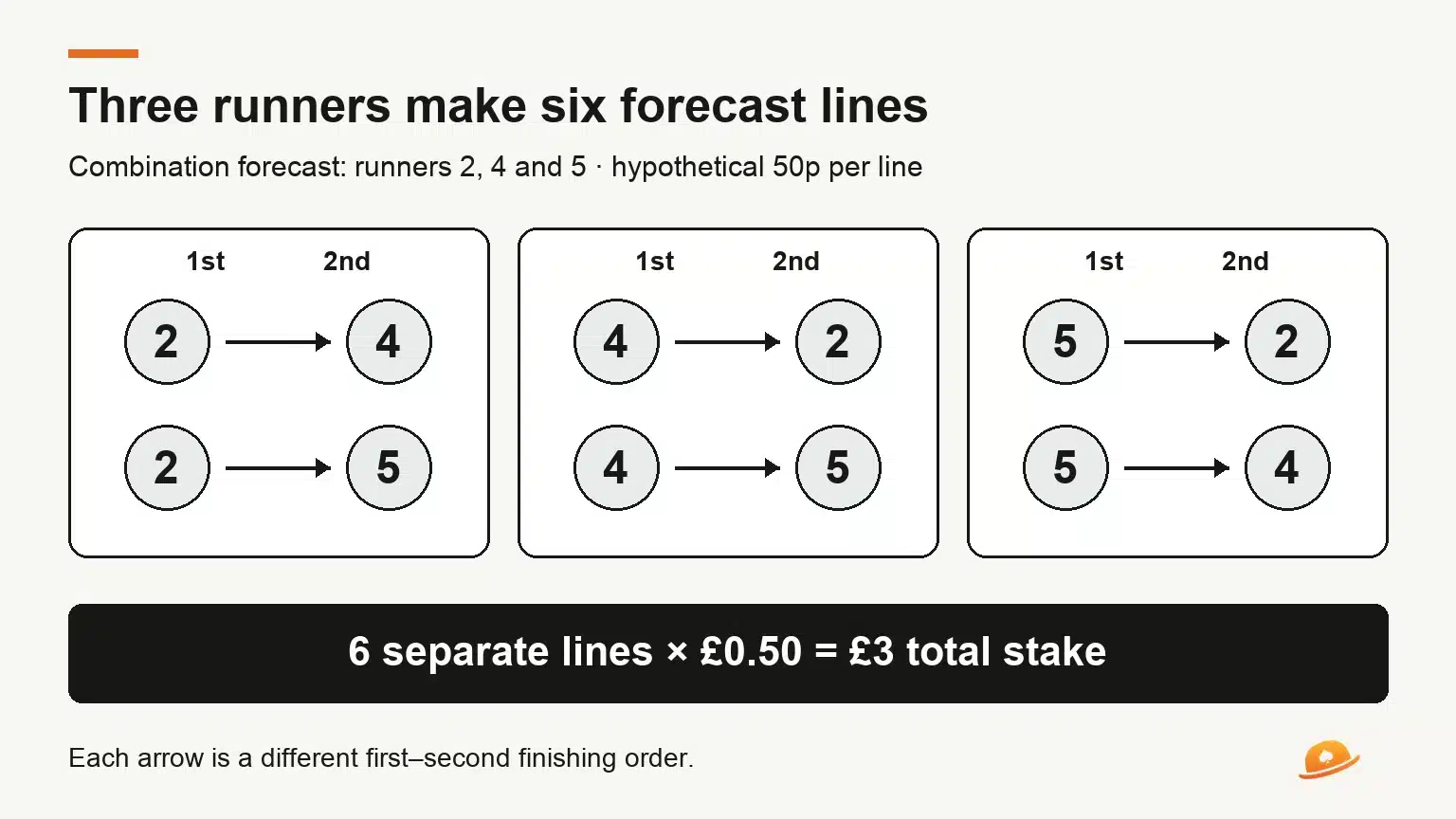
In the examples below, the numbers identify the selected runners. All stakes are hypothetical, at 50p for each separate line.
| Bet | Required finish or orders covered | Separate lines | Total stake |
|---|---|---|---|
| Straight forecast: 2 then 5 | 2 first, 5 second | 1 | £0.50 |
| Reverse forecast: 2 and 5 | 2–5 or 5–2 | 2 | £1.00 |
| Combination forecast: 2, 4 and 5 | Any two of these three, first and second in either order | 6 | £3.00 |
| Combination tricast: 2, 4 and 5 | All three in the first three places, in any order | 6 | £3.00 |
For the three-runner forecast, each dog can be first with either of the other two second: three times two gives six lines. Adding more dogs increases the cost, even when the stake box still shows the same small amount per line. Your bookmaker may set a different minimum stake or offer different combinations from this illustration.
A dividend-based forecast or tricast is settled using the declared return for a unit stake, often £1. For a hypothetical £18.40 dividend per £1, a winning 50p line returns £9.20. If it is the only winning line on the £3 combination above, the overall profit is £6.20. Subtract the whole ticket’s cost, including its losing lines.
Some markets instead offer fixed odds for the selected finishing order. Read which version is on your slip: the win odds beside each individual dog do not tell you the forecast or tricast payout.
Trap challenges cover more than one race
A trap challenge, where offered, backs a trap number across a specified set of races rather than one named dog. A common version counts which trap supplies the most winners at the listed meeting. The covered races and treatment of dead heats or an unfinished meeting belong to that market’s rules.
Fixed odds, starting price and best odds guaranteed
Suppose two online bookmakers quote 4/1 and 9/2 for the same dog in the same win market, with matching settlement terms. A winning £4 cash stake returns £20 at the first price or £22 at the second, including the stake and assuming no deductions. The difference is £2 without changing your stake. Our explanation of fractional and decimal odds covers the conversion.
Taking a price normally fixes the odds when the bet is accepted, subject to the rules for changes such as withdrawals. Choosing starting price, or SP, leaves the price to be determined at the off. You cannot know its final value when placing an SP bet in advance.
Best odds guaranteed can replace an eligible early price with a bigger SP. It is a promotion with its own conditions. An offer advertised for horse racing may not cover greyhound racing at all. Look for explicit greyhound eligibility, the qualifying time and any excluded markets before including it in your price comparison.
Non-runners, reserves and re-runs
The racing authority decides the official race result. The bookmaker’s greyhound rules explain how that result, a withdrawal or a reserve affects your particular bet. A rule about organising the race does not by itself establish your payout.
Trap betting or a named dog: what your slip says
Imagine the dog originally listed in trap 3 is withdrawn and a reserve takes its place. A bet on the named dog may be void, returning the cash stake. A bet recorded on trap 3 may continue on the replacement. Where a reserve is included, the bookmaker may also replace the original price with SP or another price specified for that market.
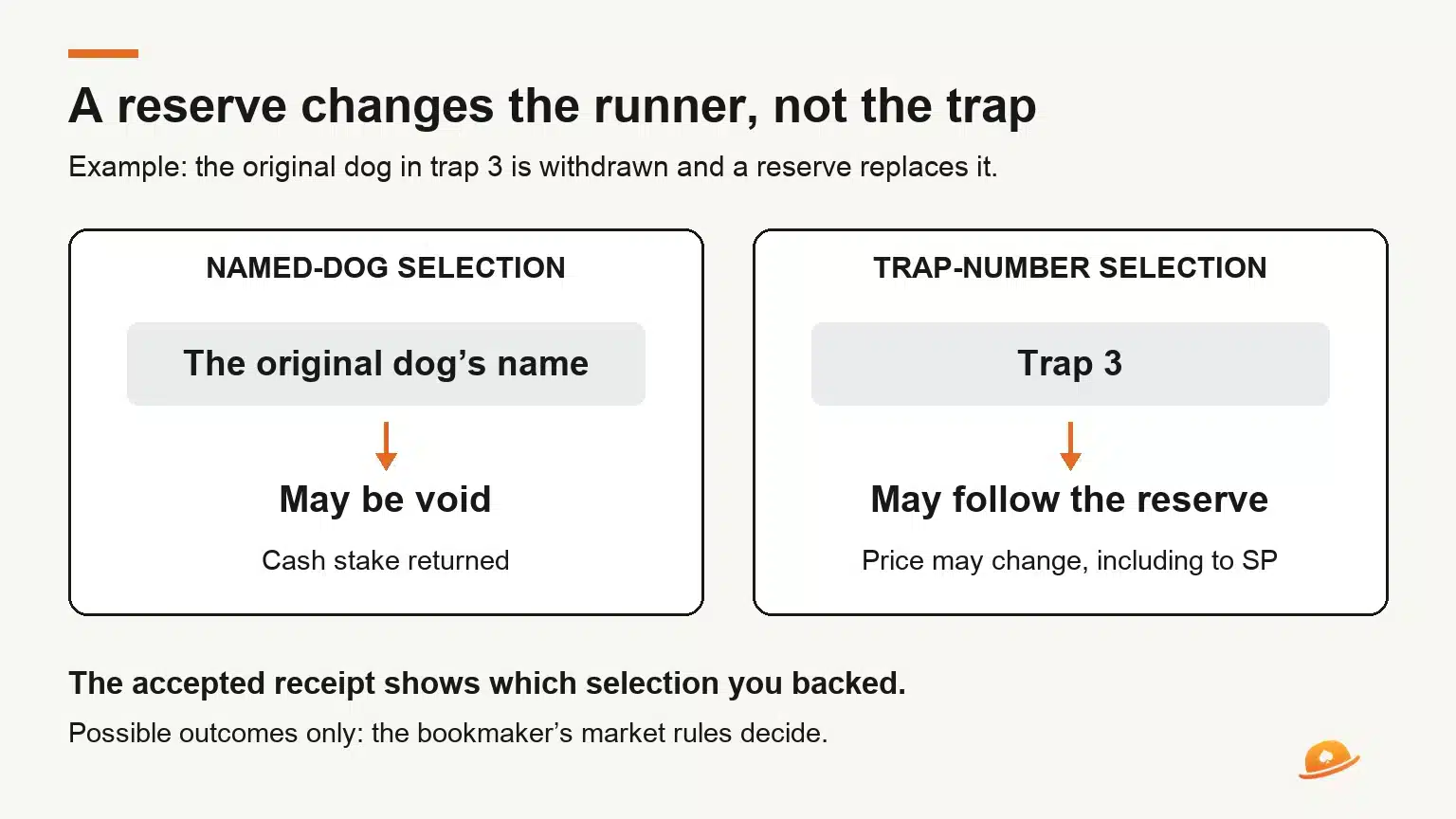
This is why the accepted bet receipt matters. It identifies what you backed before the racecard changed. A screen showing the replacement dog’s name afterwards is not enough to establish the terms of your earlier selection.
A non-runner can affect bets on the other dogs too. One bookmaker may settle the remaining selections at SP, while another provides for a deduction from winnings. Do not assume a horse-racing Rule 4 calculation applies unchanged to every greyhound market.
Ante-post and re-run rules need separate checks
An ante-post bet on a competition winner commonly loses if that dog does not take part, unless the offer specifically provides a refund. That is different from an ordinary race bet’s non-runner treatment. The price for the whole competition should not be compared with the price for winning one heat.
If a race is declared void and re-run, your original bets may carry over. Published rules differ on whether an early price survives or settlement moves to SP, so a re-run is not automatically a refund followed by a fresh betting opportunity. When a void race is not re-run, the ordinary race markets are generally voided; check separate ante-post or meeting-wide bets against their own terms.
A dead heat reduces the winning stake
For a two-dog dead heat for first, the standard win-bet calculation treats half the stake as winning and half as losing. On a hypothetical £6 cash win bet at 5/1, £3 is paid at those odds, giving an £18 return. After the original £6 stake, the profit is £12. This assumes no other deduction.
Dividing only the advertised profit by two would give the wrong answer. Forecast and tricast dividends can have their own dead-heat treatment, so the single-win calculation should not be applied to them automatically.
Live streaming and in-play greyhound betting
A race playing on screen does not mean you can still bet on it. A greyhound betting section may show live video alongside prices for the next race, with betting closing at the off. Live betting, also called in-play betting, means the market accepts bets after the race has started; check that it is actually offered for the selected race.
Live streaming access can depend on your location and account eligibility. Open the listed meeting’s viewing conditions before relying on it for the evening. Video can also be delayed, so a price or closed market may already reflect action you have yet to see.
Cash out is another feature to check at bet level. A quote can change or disappear before acceptance. If your plan depends on getting some of the stake back during the race, that money remains at risk; an available button earlier on does not guarantee a later offer.
Betting offers and withdrawals
A welcome package for new customers may award several different rewards, and greyhound bets may not qualify for every one. Read the sports and bet-type restrictions before treating a free bet or bet credits as usable on the dogs.
The qualifying bet can have minimum odds, a required stake and an opt-in deadline. An excluded payment method can also prevent qualification. Keep the deposit within your existing budget rather than increasing it to reach a bigger reward.
A free bet needs its own return calculation. If the token’s stake is not returned with winnings, the cash-stake examples in this guide will overstate what comes back. The offer should explain that treatment and when the free bet expires.
For withdrawals, start with the method you intend to use. Find its verification requirements and whether the stated waiting time includes arrival at your bank. A request marked approved can still be awaiting payment delivery; it does not necessarily mean the money is available to spend.
Set a limit for the whole meeting
Six 50p forecast lines cost £3 before the next race even starts. If you choose to bet on greyhound racing, allow for the total across the meeting, including both halves of each-way bets and all combination lines. A small number in one stake box is not the evening’s budget.
Account deposit limits and time-outs are useful responsible gambling tools. A losing race does not make the next selection more likely to win. If you find yourself raising stakes to recover losses, stop and take a break. Sports betting is for adults aged 18 and over; GamCare offers gambling support.
Greyhound betting questions
Is trap 1 always the best choice?
No. The trap number describes the starting position, not a ranking. The dog’s running preference and the rest of the field matter, and a particular trap cannot guarantee a win.
Does each-way greyhound betting pay for third place?
Only when the terms for that race include third. Two-place terms do not pay a third-place finish. Check both the number of places and the odds fraction, especially if the field changes.
What happens if a forecast selection is a non-runner?
Some rules turn the affected forecast into an SP win single on the remaining runner. A combination ticket contains separate forecasts, so the whole ticket does not necessarily receive one blanket refund. Reserve selections can also be treated differently.
Are virtual greyhound races the same as real races?
No. Virtual greyhound racing shows simulated dog races, with no animals competing at a track. Real racecard form does not describe those simulated runners. Look at the product label before comparing markets or using an offer.
Can a winning forecast leave the whole ticket at a loss?
Yes. A combination can have a winning line but return less than the cost of all its lines together. Subtract the total stake from the full return to work out the result for the ticket.
Daniel is a content creator at Mr Win and has worked in the iGaming industry since 2012. With more than a decade of experience reviewing casino operators and bonuses, he focuses on safe play, licensing standards, and helping players find fair gaming sites.
Fact checked by: Greg – Casino expert. Last fact-checked: October 16, 2026.